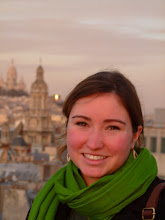
Well after our wonderful weekend in Dublin, many of our group expressed regrets that we had chosen to go there for our long weekend instead of Prague. And although Dublin was great, I think we made the right choice. 7 of us: Jenn, Carleigh, Carolyn, Peter, Wright, Miles, and I set off for Roissy (Charles de Gaulle airport) at 6:32am on Wednesday morning. After a a few minor difficulties finding our terminal (read: sprinting through the airport with our numerous carry-on bags) and making a connection in Frankfurt (I can now say I have been inside the country of Germany), we arrived in the Czech Republic. I have to say I had a pretty romantic picture of Prague in my head: I was hoping it would snow so we could have snow-capped buildings, preferably with classical music playing following our party around the city. Wright, on the other hand, pictured a post-communist waste-land. Reality was, unsurprisingly, somewhere in between. The sky was grey when we landed and the bus ride from the airport to the city center gave us a taste of the landscape: oddly grey despite the abundance of verdure.
Our hostel was located right off of Wenceslas Square (yes, like "Good King Wenceslas" from the Christmas Carol). We opted for this hostel right inbetween the "Old Town" and the "New Town" (which is still over 500 years old). We were there from Wednesday until Sunday afte
 rnoon, and I feel like we really made good use of our time. Here's a rough outline of what we did:
Wednesday evening: dinner at U Neklana, a restaurant which was recommended in Jenn's Lonely Planet "Prague" guide for its good, cheap Czech food. We absolutely loved it! It was the best food we had all weekend, and we had plenty of good food. Of course, I took plenty of pictures:
I have never heard people rave about Czech food, but I really enjoyed it. It was definitely quite different than anything I've tried before. But as much as I enjoyed it, it's probably a good thing I didn't decide to study abroad in Prague: if you think the French use a lot of saturated fat in their food, just try plate upon plate of sausage, potatoes, and cheese. But it tastes so good! And, there is a little more to it
 than that. First in the food pictures is Carleigh with her dumplings: they were stuffed with onions and grilled sausage. We had a lot of dumplings over the weekend and discovered many different varieties: the kind that were served with goulash were light, sort of spongy pieces of sweet bread, with a flavor akin to pain viennois here in France. The dumplings on Carleigh's plate were denser, probably made with potatoes and very filling (we all passed around the plates and tried a little bit of everything). Carolyn ordered weiner schnitzel and the preparation was similar to what I had in Vienna. Peter, Wright, and Miles all ordered the goulash, an excellent choice. The French equivalent of goulash is called boeuf bourguignone and it happens to be a specialty of the region which includes Dijon. But here in France they make the sauce with wine and in the Czech Republic they mak
 e it with beer. This goulash was by far the best we had all weekend: the sauce was simultaneously sweet and surprisingly spicy: we found hints of maple syrup, brown sugar, pepper, and many other flavors (after all of our degustations I think everyone is better at analyzing flavors). The goulash was served with potato latkas. Jenn ordered half of a duck, which I did not sample but she raved about it. I had the potato soup, which may seem boring, but it was exactly what I wanted. It was more of a vegetable soup than just potato soup and it contained brussel sprouts, asparagus, potatoes, and was served in a rye bread bowl. The rye bread went very well with the flavors of our dishes. All of us tried the Pilsner Urquell, the most well-known brand of
  beer from Prague. Peter ordered a Kozel next and after tasting this darker, richer beer I found that I prefered it, especially with the flavors of the food. It's amazing how the Pilsner tasted just fine before we started to eat, but with the food it tasted a little sour. The Kozel complimented the flavors much better. Anyway, for dessert we ordered fruit dumplings, which the guidebook mentioned. They were enourmo
 us, stuffed with prunes, topped with whipped cream and clotted cream, and then dusted with chocolate powder. It was way too much, but very tasty. After all of that good food we walked back to the Old Town and wandered around that district for a little while. It wasn't too cold outside, actually it was quite pleasant. But it probably helped that our bellies were so full of all of the dense Czech cuisine, it really is true that that kind of food keeps you warm.
Thursday
- Free 3-hour walking tour with Sandeman's : when we first heard it was free we
 were a little skeptical, but it turned out to be a great choice. Our guide Ruth was very enthusiastic and she showed us around the Old Town, New Town, Jewish Quarter, and pointed out a few of the other sites. Honestly before I went to Prague I knew very little to nothing about the history of the Czech Republic or really any Eastern European history at all. After reading the guidebook on the plane, taking this tour, going to the Museum of Communism, and taking a tour of Terezin, I feel very well informed. The history of Bohemia/Czechloslovakia/the Czech Republic is very much a long list of outsiders who came in and ruled: first the Germans, then the House of Luxembourg, then the Hapsburgs, then 20 brief years of independence, then the Nazis, then the Soviets, and then, in 1989, independence. Our timing was actually quite apt because the 20th anniversery of the fall of the Berlin Wall was November 9 (we arrived on the 11th) and so many of these important dates were being celebrated/noted during our visit. The picture is of the astrological clock in Old Town Square. Prague has many buildings done in the Art Nouveau style, which I have probably seen before, but never in this quantity. Carleigh informed me that Art Nouveau was a movement in reaction to the sterility of the Industrial Revolution. It's very different from the architecture I have seen in France (the only major example of Art Nouveau in France is on the metro stations in Paris). I could list everything we saw on the tour, but it would probably start to sound like Frommer's instead of a blog. So suffice it to say that the tour was both informative and interesting and that I highly recommend that you go to Prague if you ever have to opportunity.
 - Museum of Communism: or, why I love America. No joke, America has some serious problems, but compared to the kinds of suffering people have felt under other systems, I think we're doing okay. The most interesting part for me was seeing all of the propoganda posters and the photos and videos of the demostrations and riots throughout the communist regime (roughly 1946 to 1989). The police brutality against the demonstrators was really impressionable. I bought a postcard for my friend Hope which shows three women standing proudly and reads "They would have burned their bras like their sisters in the West, if only there has been any in the stores."
- Classical music concert at the Church of St. Nicholas on Old Town Square: this wasn't quite as good as the Vivaldi concert we heard in Paris, but it was significantly less expensive and the price/quality was probably equivalent. We heard pieces by Handel, Mozart, Bach, Vivaldi, and one or two others, performed by an organist and a pianist.

- Terezin: small fortress and the town. This took up a good portion of the day. Terezin is the name of the town which was used by the Nazis as a ghetto for Jews during the occupation of Czechloslovaki. Upwards of 150,000 Jews passed through there, and most of them were sent to Auschwitz and other concentration camps where they were murdered. The small fortress was a prison which held political prisoners. We purchased tickets through a tour venue and left on a bus at 9:15am, returning around 2:15am. Terezin is 60 km north of Prague. Before 1940 there were 110,000+ Jews living in Czechloslovakia and after the Germans started enforcing the Nuremburg Laws and persectuting them, there
 were around 80,000 still living there. Less than 10% of those 80,000 survived the next 5 years. The small fortress at Terezin didn't have any gas chambers or anything like that, but the conditions were still inhumane and shocking. Some of the cells which were originally intended to be a stall for one horse housed 18+ people. A room which might have comfortable held 50 people was inhabited by 600. It was heartbreaking. The Nazi guards lived right next to the compoud in relative luxury (they had a cinema, a swimming pool, and beautiful gardens, all of which remain today). And they lived there with their wives and children! How unbelievable, that they were able to treat other human being so cruelly and do it in such close proximity to the normalcy of a privileged family life. When I think about Holocaust deniers like the shah of Iran it makes me so angry - denying that the Holocause ever happened seems almost as bad as being someone who perpetrated it.
 - Giant park with the metronome
- Dinner, overpriced and not as good as Thursday
- "Ghost Tour" of the Old Town, quite disappointing

- Petrin Hill
- Prague Castle (St. Vitus' Cathedral and the museum)
 This picture is overlooking the Vltava River (which divides Prague), with Prague castle behind it
 - Dinner with Miles' friend Whitney and her boyfriend Amund

- Jewish Museum: Pinkhaus Synagogue, Old Jewish Cemetery, Cemetery museum