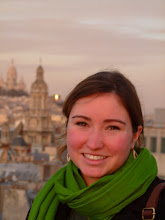
The ladies (minus Mary-Kate, who was in Toulouse this weekend). L to R: Carleigh, Jenn, Carolyn, me, Kara
 This was Saturday night, I straightened my hair for a change of pace
 So last night I went out to dinner with the Ultimate Frisbee team, Les Discjonctes. We met at Franck's apartment and then walked to Le Palmier, a Moroccan restaurant. This was the first time I've hung out with the team outside of practice, and I was really looking forward to it. When I arrived at Franck's apartment though (it was only a 20 minute walk from my house), I was immediately intimidated. I guess I hadn't realized how at practice I am not required to speak or follow a conversation for a majority of the time - just play. Here it was me and 20 other francophones, and I was doing my best to keep up with the conversation and not sound too much like a bumbling American. Don't get me wrong - everyone on the team was just as friendly and welcoming as usually, maybe even more so. I was just much more aware of my language flubs, without the game to distract me. It was a lot of fun though. I'm so glad that I have the team here in Dijon. Not only is it fun to play Ultimate again, it's so cool to get to spend time with Dijonnais. CIEF is a good program, but it isolates the international students from actual French students. So while I am taking classes at the University of Burgundy, I have yet to actually talk with a French student there. Anyway, dinner was great. My chicken tajine was delicious and not too pricey, I would definitely go back. When I went up to pay for my meal, I discovered that our two servers were both native Fassis (from Fez, Morocco) and that they had been there this summer when I was there. Obviously Fez is a big city, but I still felt like it was kind of a cool coincidence.
And then this afternoon was degustation #5 with Monsieur Lafond. Tonight we learned the rest of the basic terminology for following a professional degustation. Part of me is a little frustrated that we didn't really learn how to assess the wine completely until this evening, but the other part of me understands that there is no way we could have absorbed everything in the first session. I'm going to attempt to sum up our course so far in a few brief lines:
Session #1: Why are Burgundy wines unique? The answer being the soil, specifically the amount of calcium in the soil
Session #2: How grapes are grown to make wine
Session #3: How the grapes are turned into wine
Session #4: How to "déguste" (sample, taste) a wine (assessing the level of acide and moelleux [mellow, or "buttery"] in a white wine)
Session #5: More on how to déguste a wine (assessing the level of acide, moelleux, and tanin, assessing the aromas (based on four categories: végétale, animal, épices, feu)
A few quick facts I've learned about Burgundy wines:
- There are only four cépages grown in Burgundy, two white (Chardonnay and Aligoté) and two red (Pinot Noir and Gamay). Chardonnay and Aligoté always come from grapes with white skin and white juice, and Pinot Noir and Gamay come from grapes with red/purple skin and white juice.
- Gamay is the only one of the four which is not grown on a calcium-rich soil, it's grown on granite
- For a white Burgundy wine there are four classes (in ascending order, according to quality/finess): Bourgogne --> Village --> Premier Cru --> Grand Cru. So wines of a certain quality are only allowed to put "Bourgogne" on their label, not the village name or "Premier Cru." The difference in quality of wine is all about location, the best crus come from the places where the cépage is best acclimated to that particular soil's composition.
This evening at the degustation we tried five different wines: Aligote 2007 (our reference wine, the same one we have been trying every week since the first session), a Bourgogne red 2006 (this is by default a Pinot Noir because almost all of the Gamay is made into Beaujolais), a chardonnay village 2005 we tried on Monday evening, than a Mersault chardonnay village 2005, and a Mersault chardonnay premier cru 2005. What was really interesting about the progression of wines that we tried tonight was that I was able to identify and savor more flavors/aromas in the Mersault chardonnay village than the premier cru. You would think the premier cru would be definitively better, since it's of a higher echelon. The aromas were much finer, but not as well developped. M. Lafond explained that that particular wine would be much better in a few years, it was still too young to really achieve its full potential. Having him explain the four categories of aromas made it easier to approach the wine. Rather than just looking for n'importe quoi (anything), I could think to myself, "okay, do I smell any flowers, white fruits, earthy/grassy aromas...okay...now animal scents like meat, leather, animal skin..." and so forth.
Our next session isn't for another two weeks, but if you can't tell, it can't come soon enough for me. M. Lafond really has done an excellent job imparting so much of his knowledge to us, but in a way that's concise and approachable.
Oh but the day's adventures weren't over yet. I raced home on my bike and just caught Noelle, Orane, and Pedro finishing dinner. Pedro is a Swiss student who is staying in Dijon for two weeks on a "séjour linguistique." When I asked what that entailed, I was informed it means that he takes French classes all day long and spends the night with a host family. Pedro is actually from Brazil and he speaks German, Portugese (and the Brazilian variety of Portugeuse, sort of like the Mexican version of Spanish), French, and a little English. I thought I should tell you just in case you were starting to get impressed with my French and humble amount of Arabic...
After dinner Orane and I font des cookies ensemble! My extensive searching and trips to various grocery stores paid off because the two of us together made a batch of oatmeal chocolate chip cookies to rival any which have ever come out of the Dayton family kitchen (and without baking powder!) I chopped the chocolate chips by hand, but they were dark chocolate and probably even better for it. It was really cute, actually. Noelle turned the kitchen totally over to us and Orane and I donned aprons and everything. She tried to speak only in English (to practice), but we abandoned that pretty quickly. I feel like I haven't spent very much time with my host family this week: classes, Les Discjonctes, the degustation, and everything else, have kept me running around like crazy. Orane is really very sweet. She was so eager to make the chocolate chip cookies and I think we were equally pleased that they worked out so well. I helped her with her English homework afterwards too. It required translating English sentences into French, so it was good practice for me too. Tonight was a great example of how home-stays can be so rewarding. I got a chance to hang out with Orane, a French girl very close to my sister Holly's age, and just do something fun together. We got to make one of my favorite treats from home, which is one of her favorite treats too. We spoke a lot of French and she got to practice a little English. We ate cookie dough. I can't think of a better way to overcome cultural barriers.
So tomorrow: Dublin! Ah!! Now, time to sleep. Oh, and since you made it to the end of the blog post, I should probably explain the title, as a kind of a reward. "Sol Calcaire...belle couleur" is one of the first catch-phrases M. Lafond taught us (I think this was our first or second dégustation). He told us we can use it whenever we're examining a Burgundy wine (except Beaujolais/Gamay, of course). It translates to "hm...grown on a calcium-rich calcium....beautiful color." Basically it makes you sound smart, even if you don't know anything else to say about the wine. It's become kind of a joke with our group, and we've started to use it to describe random liquids/food/objects. Okay, maybe you have to be here. Anyway, bon soir! (good night!)
Our next session isn't for another two weeks, but if you can't tell, it can't come soon enough for me. M. Lafond really has done an excellent job imparting so much of his knowledge to us, but in a way that's concise and approachable.
Oh but the day's adventures weren't over yet. I raced home on my bike and just caught Noelle, Orane, and Pedro finishing dinner. Pedro is a Swiss student who is staying in Dijon for two weeks on a "séjour linguistique." When I asked what that entailed, I was informed it means that he takes French classes all day long and spends the night with a host family. Pedro is actually from Brazil and he speaks German, Portugese (and the Brazilian variety of Portugeuse, sort of like the Mexican version of Spanish), French, and a little English. I thought I should tell you just in case you were starting to get impressed with my French and humble amount of Arabic...
After dinner Orane and I font des cookies ensemble! My extensive searching and trips to various grocery stores paid off because the two of us together made a batch of oatmeal chocolate chip cookies to rival any which have ever come out of the Dayton family kitchen (and without baking powder!) I chopped the chocolate chips by hand, but they were dark chocolate and probably even better for it. It was really cute, actually. Noelle turned the kitchen totally over to us and Orane and I donned aprons and everything. She tried to speak only in English (to practice), but we abandoned that pretty quickly. I feel like I haven't spent very much time with my host family this week: classes, Les Discjonctes, the degustation, and everything else, have kept me running around like crazy. Orane is really very sweet. She was so eager to make the chocolate chip cookies and I think we were equally pleased that they worked out so well. I helped her with her English homework afterwards too. It required translating English sentences into French, so it was good practice for me too. Tonight was a great example of how home-stays can be so rewarding. I got a chance to hang out with Orane, a French girl very close to my sister Holly's age, and just do something fun together. We got to make one of my favorite treats from home, which is one of her favorite treats too. We spoke a lot of French and she got to practice a little English. We ate cookie dough. I can't think of a better way to overcome cultural barriers.
So tomorrow: Dublin! Ah!! Now, time to sleep. Oh, and since you made it to the end of the blog post, I should probably explain the title, as a kind of a reward. "Sol Calcaire...belle couleur" is one of the first catch-phrases M. Lafond taught us (I think this was our first or second dégustation). He told us we can use it whenever we're examining a Burgundy wine (except Beaujolais/Gamay, of course). It translates to "hm...grown on a calcium-rich calcium....beautiful color." Basically it makes you sound smart, even if you don't know anything else to say about the wine. It's become kind of a joke with our group, and we've started to use it to describe random liquids/food/objects. Okay, maybe you have to be here. Anyway, bon soir! (good night!)